Everyone knows a cat’s gonna cat, but the reasons behind these quirky cat behaviors aren’t always widely known. Like, why does your cat make biscuits constantly? Or why do you always seem to find them sitting on top of your high bookshelf? When you take a closer look at these common cat behaviors, you'll find there are very good and fascinating reasons behind why your pet does what they do.
Why Cats Knead
Kneading, often referred to as "making biscuits," is a behavior cats carry over from kittenhood. According to the American Animal Hospital Association (AAHA), "Kneading is an instinctive trait in cats, who often knead of a soft surfcae, such as a blanket, other cats, or your lap."
Why do they do it? When kittens knead their mother's teats while nursing, it stimulates the flow of milk, which brings the kitties comfort and satisfaction. That's not to say grown cats knead because they are hungry or looking for milk.
In weaned kittens and adult cats, it's more of a comforting behavior. "Happy cats appear to knead to show pleasure," AAHA reports. Learn more about why cats knead.

Cats also have scent glands in their paws, so kneading provides a way for them to mark people, areas, and items in order to stake a claim on them.
Why Cats Purr
Purring is music to a cat-lover’s ears, but why exactly does it mean? Veterinary behaviorist, Dr. Barbara Sherman, PhD, DVM, DACVB, DACAW, says, "In general, purring is associated with positive cat-human interaction or positive cat-cat interactions."
But they can purr in different scenarios, too. Dr. Sherman adds, "In addition, purring may occur just prior to sleep, or, surprisingly, when in pain. When veterinarians examine a cat presented for emergency treatment after having been hit by a car, they may note that it is purring."
Interestingly enough, the frequency of a purr is between 25 and 50 Hz, which is within the range of vibrational frequencies that are said to help with bone and muscle repair. So does this mean cats' purrs are healing? It’s possible.
Why Cats Rub Against Things (Including You)
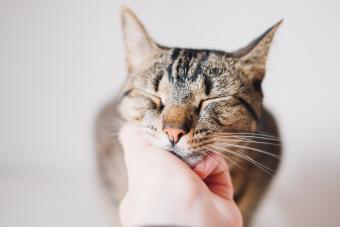
Cats have scent glands in their faces, and they like to rub them on objects to mark them with their scent pheromones. Dr. Amy Sawy, DVM of the Feline Veterinary Emergency Assistance Program, explains, "Your pet does this as they want you or the object to start smelling like them. In a way, it is similar to marking their territory." Take this as a compliment because it absolutely is! Check out other reasons cats rub against everything.

A lot of people refer to this cat behavior as "head butting," but the true term is "head bunting." Either way, it's the same thing.
Why Cats Scratch Furniture
Scratching can be a frustrating behavior for cat owners, but once you understand the reason behind it, you’ll have more success in redirecting your cat’s scratching. First, know that scratching is something cats must do. The action helps shed the outer layers of their nails to keep them healthy.
But that's not the only reason cats scratch. According to the Cornell Feline Health Center, "Scratching is largely a marking behavior that deposits scent from special glands on the cat's paws into his territory and removes the translucent cover, or sheath, from the claws."
You can actually buy products that mimic these scents, called synthetic interdigital semiochemicals (FIS), to apply to your cat’s scratching post as a way to encourage them to scratch there and only there. Cool, right?

Helping your cat find appropriate places to scratch, like a homemade cat scratcher, doesn't have to be a pain. You can use cat attractants, like catnip, to show your kitty where to scratch and deterrents to keep your cat away from areas you'd rather them not (like your couch.)
Why Cats Twitch and Flick Their Tails
Cats use a lot of cues to communicate with people and other cats, and one of the most obvious ways is through tail positions. It's an entire language, really. Cat behavior expert Pam Johnson-Bennett states that "The tail's position or movement are mood indicators, and if you pay attention, you can gain insight about what your cat is feeling." Pam explains a few of the common tail positions and their meanings:
- An upright tail position means a cat is comfortable in their surroundings.
- A slightly horizontal tail position means a cat is relaxed.
- A tail wrapped around the paws is a relaxed cat that "would prefer not to engage" or one that's feeling unsure.
- A tail held low means a cat is "not so happy at the moment."
- A tucked tail is a cat that's very fearful.

Why Cats Crouch
Crouching is part of feline stalking behavior, and it often means your cat is getting ready to pounce. In the wild, the cat would be preparing to pounce on prey, and domestic cats still exhibit this behavior in the house by playfully pouncing on toys, their housemates, or even your foot.
But a crouched cat who isn't stalking is uncomfortable. The feline behavior professionals at Florida Veterinary Behavior Service explained, "Generally, the crouched position is one of defensiveness, self-protection, or fear. It is a yield sign. That means that interaction with a cat in this position could end well or poorly."

Why Cats Lay Down & Roll
When a cat stretches out and exposes their underside, this puts them in a very vulnerable position because all their vital organs are exposed. You can rest assured that a cat feels truly safe and secure in their home when they lie or sleep with their belly showing.
In other scenarios, rolling onto their back while playing or fighting could indicate that your cat feels threatened. According to Pam, cats sometimes roll onto their sides when fighting because this position frees up all four of their paws for scratching. If your cat's holding their paws out with claws extended, they are ready to scratch anyone who comes near. Discover more about why cats lay down in weird places.

Why Cats Meow
Did you know that cats don't generally meow to each other? John Bradshaw, arthrozoologist and author of Cat Sense: How the New Feline Science Can Make You a Better Friend to Your Pet, states, "The meow is usually directed at people, so rather than being an evolved signal it’s more likely to have been shaped by some kind of reward. Cats need to meow because we humans are generally so unobservant."
Some breeds, like the Siamese, are known to be more "talkative" than others, but this varies from cat to cat. And, of course, many cats will meow at night. However, if you notice a sudden change in the frequency or intensity of your cat's vocalization, this could indicate a medical or behavioral problem, and a trip to your veterinarian is warranted.

Why Cats Chatter
Unlike meowing, cats rarely chatter at us humans, instead reserving it as super-excited exclamations. You might hear your cat chatter at a bird out the window, or when you bring out their favorite toy. Why? Animal behavior expert, Mychelle Blake, breaks down the five most common reasons cats chatter:
- It's part of hunting
- They're excited
- They're frustrated
- It may simulate a "kill bite"
- They may have dental issues
Blake uncovered some interesting research on the topic and shares more details in why cats chatter.
Why Cats Slow-Blink and Stare at Us
If you're never heard of the cat "I love you" this is a treat. Many cat behavior experts have pointed out that cats show affection and trust by doing a sort of semi-stare and soft, slow blink. In fact, acclaimed cat expert and TV personality Jackson Galaxy recommends you try to do it back as a fun way to bond with your cat.
However, cats stare (sometimes creepily) at us for a variety of reasons, like:
- General curiousity
- Anger
- Wanting something
- Fear
- And the fact they don't actually blink very often
Find out how to interpret why your cat is staring at you.
Understanding Common Cat Behaviors
Cats do a pretty good job communicating with humans and their fellow felines through a series of different sounds, movements, and positions. By learning the motivations behind the most common cat behaviors, you can understand what your cat is really trying to tell you.