Dealing with cat urine is one of the most difficult parts of owning a cat. Regular household cleaning products usually won't get rid of the stains or odor, but there are some tried-and-true methods pet owners have perfected over the years. Use these tips on which cleaning methods work best for cat urine on couches, carpets, hardwood floors, and more.
If your cat's not liking his litter he may find someone else to "go." Check out our favorite cat litter attractants to bring kitty back to the litter box again.
The Science: Why Cat Pee Is So Hard To Clean
Like all urine, cat urine is mainly made up of urea, urochrome, and uric acid. Uric acid is the component of urine which makes it so hard to clean. Most cleaning products will get rid of urea and urochrome, often creating the illusion that the urine has been removed. However, uric acid is made of crystals which are non-soluble and bond tightly with surfaces, thus traditional cleaning products cannot break them loose or dissolve them.
When the other components of urine are removed, the appearance and odor often go away temporarily, only to come back when the area becomes damp. The traces left behind may not be noticeable to humans, but cats can still smell them and are attracted to the area for urination.
How to Find Cat Urine With a Black Light
Sometimes you can just smell cat pee but don't know where it's coming from. Did it dry on the wall? Soak into the carpet? Fortunately, you can easily use a black light to locate the problem area.
To do this, simply turn off the lights so the room is dark, then scan the room with the black light. The urine should glow fluorescent. Now you know exactly where to clean.
Intact male and female cats are more likely to spray urine as a marking tactic, so neutering and spaying your cat is the best way to help stop cat spraying.
How to Clean Cat Urine
The method you should use for getting rid of cat urine can vary based on the age of the stain as well as the type of surface it's on. Follow up with the black light to make sure you got it all.
I've gone with a vinegar-based cleaning solution here which can break down the crystals in the urine to stop your cat from coming back, but you may need to use an enzymatic cleaner for extra-stubborn spots.
From Carpets

- Blot up as much of the liquid as you can using a clean, dry paper towel or cloth.
- Saturate the area by misting it with a 50/50 mixture of vinegar and water.
- Allow it to sit for 10 to 15 minutes.
- Blot the area again using a paper towel or clean rag.
If the odor is still there in a couple of days, or if your cat keeps returning to the area to urinate, you will need to use an enzyme cleaner on the carpet.
From Couches

- Blot the cat urine with dry paper towels or a clean cloth to pick up as much liquid as you can.
-
Add 1 tablespoon of dishwashing detergent and 1 tablespoon of vinegar to a spray bottle containing 2 cups of cold water.
-
Mist the area with the mixture until it's completely saturated.
-
Let it sit for at least 15 minutes.
- Blot the area again using a clean, moist towel or remove the moisture by using a we/dry vacuum.
Always test solutions on a small portion of your furniture in a hard-to-see area before using it in a larger section. This will help you know if the solution is going to stain your upholstery.
From Mattresses

- Remove your bedding right away.
- If it's a fresh urine spot, blot it with a paper towel or cloth to soak up as much liquid as you can.
- Combine 1 cup of 3% hydrogen peroxide, 1 tablespoon of liquid dish soap, and 1 tablespoon baking soda.
- Mist the area with the mixture until it's completely saturated.
- Let it sit for 15 minutes.
- Then, sprinkle a good amount of baking soda over the area on the mattress.
- Let it sit overnight or for at least 5 hours.
- In the morning, vacuum up the baking soda.
Related: 6 Reasons Your Cat is Peeing on Your Bed, and How to Stop It
From Hardwood Floors
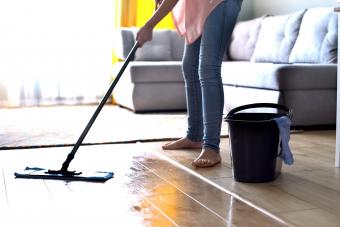
- Use dry paper towel or a clean rag to blot up as much of the liquid as possible.
- Make a solution of 50/50 vinegar and water in your mop bucket or a spray bottle.
- Use a mop or cloth to clean the area, making sure you don't saturate the wood completely.
- Thoroughly dry the floor to prevent any warping.
From Tile With Grout
- Blot up as much of the urine as you can using a paper towel or clean cloth.
- Prepare a mixture of 50/50 vinegar and water with the addition of 1 tablespoon of dish soap.
- Spray the solution on the tile and grout and allow it to sit for 15 minutes.
- Then, use a clean brush to scrub both the tile and grout.
- Blot up excess moisture, then use a clean, damp rag to wipe up any of the remaining solution.
- Dry both tile and grout thoroughly.
Old Stains and Repeat Spots
If your cat keeps peeing in a specific place, old urine stains may be causing the problem. If a cat is spraying, the urine will usually be up high, about nose level for the cat, rather than on the floor. Even urine that is imperceivable to humans can be smelled by cats and dogs. They will continue to use the spot if there is any residue left behind. Make sure to use the black light around the whole area after everything is dry to ensure you got it all.
Dry urine stains should be moistened, not soaked, with water prior to the application of the enzymatic cleaner. Very old stains may require several applications before all of the uric acid is removed.
Using Enzyme Cleaners for Cat Urine
There are many brands of enzyme cleaners for pet urine. Some work very well. Others seem to do nothing at all. An effective enzyme cleaner actually eats the uric acid crystals. The key to making an enzyme cleaner work is time, patience, and saturation. Enzymes take time to do their job, and the area must stay moist, or they stop working. One way to keep the area from drying out is to cover it with plastic. Enzyme cleaners can be found at most pet stores.
If your cat pees outside of their litter box more than twice, it's important to see your vet. The quicker you find a solution to the problem, the easier it is to stop.
Cat Urine Problems Are Frustrating
Almost every cat owner will have to deal with a few urine mishaps over the course of their pet's lifetime. In fact, at least 10% of cats stop using their litter box at some point. Talking to your veterinarian as soon as it starts and learning the best ways to clean up cat urine can help nip this problem in the bud.