Manx cats are commonly known for their tail — actually, the lack of tail. Their tailless characteristic isn't all there is to them, though. They have a playful personality that'll keep you on your toes and provide endless entertainment. And that's not all. They have a list of characteristics that help Manx cats stand out in a crowd.
1. Manx Cats Are More Like Dogs
These cats are known for their dog-like loyalty and playfulness. Seriously, you may question if they're a dog in a cat's body. Some Manx cats even fetch and come when you call their name, which will surely make your dog-loving friends do a double-take.
2. They're From the Isle of Man
This breed traces its origin back to the Isle of Man off the coast of Britain. As sailors anchored in the island's ports, their cats also took the opportunity to jump ship. As a result, numerous breeds were mixed, with certain characteristics proving dominant in the breeding population.

3. They Can Have Long or Short Coats
Although most Manx cats have a short coat, there are some that are born with long coats. Some feline enthusiasts consider this a different cat breed, but they have all the same characteristics as a Manx. If you ever come across a Cymric (pronounced kim-rick) cat, just remember these are Manx cats with a different hairdo.
If you choose the long-haired version of the Manx, be prepared to brush their fur at least once per week to maintain a healthy coat.
4. They Usually Don't Have a Tail
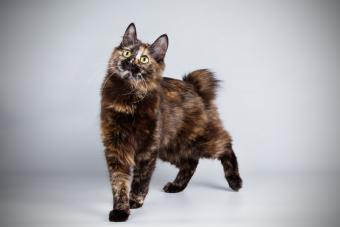
Of course, it's the Manx's tail — or lack of it — that truly distinguishes this breed from other cats. Although a Manx may be born with anything from a full-length tail to completely tailless, it's the tailless kitties that are most prized. It's believed that this genetic mutation is traced back to a single cat that came to the island via a Spanish ship.

Even cats born with full tails can produce tailless kittens when bred, and vice versa.
5. The Tailless Manx Has a Nickname
In breed lingo, a completely tailless Manx is affectionately called a "rumpy," while cats with the next best stub-length tail are called rumpy risers. Rumpies are highly prized in the world of Manx cat enthusiasts, not just for their interesting looks, but also because they most closely conform to the breed standard.
If you're considering adopting a rumpy Manx, it's important to find a vet that's familiar with the breed to understand any special care or potential health issues.
6. They Become Extremely Attached
The average Manx cat forms a strong connection with at least one member of the family. Since they become so attached to their human companions, it can be difficult for them to adjust to new homes. For this reason, if no other, you should think carefully before adding a Manx to your household, so you can provide a stable home for life.
7. They're Known to Have Spinal Deformities
The same gene that gives them their tailless rump can sometimes lead to a condition known as Manx syndrome. This can include a range of spinal issues and even problems with their digestive and urinary systems. It's a serious concern, and something you should definitely chat with your vet about, especially if you're thinking about bringing one home. It's difficult to know if a kitten is healthy until about 16 weeks old, when they start showing signs.
This is why many breeders choose to wait until their kittens are this age before allowing them to go to their forever homes.
8. They're Good Jumpers
Manx kitties are excellent jumpers. Their agility is off the charts, and it's something that often surprises people who are new to the breed. Their muscular hindquarters aren't just for show. Those muscles give them incredible leaping abilities. Some Manx cats can jump up to eight feet. So if you can’t find your cat, look up.

9. They're Intelligent
Manx cats are highly intelligent animals and are known for their ability to be trained. This is especially true if they have bonded with you since they were a kitten. You’ll often notice them following you around, even if you’re outdoors, opening cabinets they want to get into, and sneaking around mischievously, looking for what their heart’s desire. If they want it and you don’t hide it carefully, they’re getting it.
Find Your Feline Soulmate
Whether you’re looking at a rumpy or a full tail, a long-haired or a short-haired, the Manx will surprise you with their level of loyalty, adaptability, and happiness. If you want a feline BFF who will be by your side any time you’re nearby, you’ve hit the jackpot with the Manx. And hey, even if you’re just cat-curious and want to learn more, trust me, these kitties have enough charisma and quirkiness to keep you entertained and intrigued.