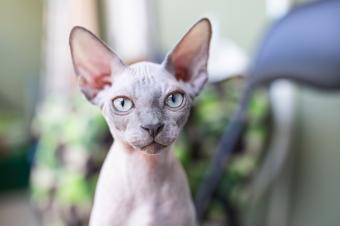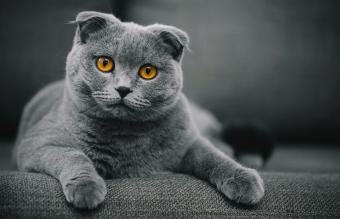
The Scottish Fold cat breed is unique in its look and calm and steady temperament. If you've never seen one before, check out the mini gallery below and learn more about the Fold's unusual ears.
Scottish Fold Breed Begins With Susie
The origins of many cat breeds are shrouded in a bit of mystery, but not so for the Scottish Fold cat. This breed actually traces back to a single female cat named Susie. Susie was a white cat that lived on a farm in Scotland. She had a distinct fold in her ears that made her quite different from other local cats. When Susie eventually had kittens, two of them actually inherited those folded ears. A gentleman named William Ross acquired one of those folded kittens and set about establishing what would become the Scottish Fold breed.
Description of the Scottish Fold Cat
Scottish Fold cats have a distinct look to them. Their ears, eyes and round head are some standout characteristics that make them truly unique.
Body
Scottish Folds are medium-sized cats that give a very rounded impression. From their prominent round eyes to their rounded heads and significantly rounded bodies, these felines are the epitome of a cuddly cat.
Eyes
The Scottish Fold's eyes rival those of the most exquisite Persian. They are quite large and round and compete with the ears for your attention. Their luminous quality has led some admirers to compare them to an owl's eyes.
Ears
Of course, these cats' most distinctive feature is the one that gives them their name. The quintessential Scottish Fold cat carries a unique set of genes that cause the ears to fold over instead of stand up like other cats. Some cats have a single fold that still distinguishes the ears a bit from the head while others have two or even three folds that actually make the ears lay flat against the head.
Kitten Ears
It's worth noting that not every kitten in a litter of Folds will actually present with folded ears. All the kittens have normal ears when they are born, but within weeks, some will begin to fold over. Although it is these kittens that will be the most desirable in the pet market and show community, the unfolded siblings are very important in the overall breeding program because they still carry the genes that produce the fold.
Coat Length
Folds come in both short and long coats. The short coat should be quite full and plush, virtually so dense that it stands on end. The long coat should be quite full and feathered on the tail, feet, and ears, and especially so around the collar. Shorter hair on the face and body is allowed although it is slightly less desirable.
Coat Color
Breeding of the foundation stock with both British and American Shorthairs was necessary to establish breed type, so many colors are permissible. However, any Fold that displays Siamese-type points, chocolate or lilac fur is not eligible for show.
Personality
This breed is known to be extremely affectionate and also quite vocal. Folds have softer voices when compared to the equally vociferous Siamese, but they have a very interesting vocabulary you can happily spend the rest of your life decoding.
Pictures of Scottish Folds
Scottish Fold cats, especially kittens, are uniquely adorable. Their big eyes and curled ears combined with many colors and patterns make for an exquisite feline picture show.


Health Concerns
Unfortunately, the same genetics that cause the unique ear fold of this breed have also been linked to degenerative joints. This mainly affects the knees, ankles, and tail, and it causes the joints to fuse together. The condition is more prevalent in cats that have two Fold parents, but it has also been noted in cats with a single fold parent.
For this reason, it's important to inspect any Scottish Fold kitten or cat for signs of this condition if you're considering adopting. You can do this by gently flexing the aforementioned joints to make sure they work properly. Never force the joints to move if they provide resistance, or you could injure the feline.
Scottish Fold Rescue
As with so many pets, Scottish Folds also find themselves within need of a home from time to time. Some of these cats are perfectly healthy and simply couldn't be cared for any more by their previous owners. Others suffer from joint fusion and need loving people to provide them with specialized care. If you're interested in rescuing one of these animals, visit Scottish Fold Rescue, Inc.
Is the Scottish Fold Your Cat?
Now that you know more about the Scottish Fold, don't hesitate to visit breeders to find out if this may be the cat for you. Make sure your household's activity level matches the needs of a Scottish Fold and that you're prepared to provide for their grooming and health care needs.