From their complex genetic roots to the different tabby pattern possibilities, orange tabby cats are fascinating creatures. We were pretty shocked to learn that these cats can range in color from a deep copper to a pale buff tabby, and that 80% of orange cats are male. Fascinating, right? Find out how these popular cats get their signature look, the exact chromosomal combination required to make it happen, and more.
There Are Different Types of Orange Cats
An orange tabby is a combination of two main traits: color and pattern. Orange tabbies, like tabby cats of other colors, come in a variety of patterns. There are four distinct tabby patterns and four possible types of orange cats.
Classic Orange Tabby
The classic tabby pattern is very common and probably the one you're most familiar with. With this pattern, the cat's fur:

- Has a random series of light and dark orange swirls
- Almost looks like the cat has been tie-dyed
- Carries the signature M marking on the forehead
Orange Mackerel Tabby
The mackerel tabby pattern is also quite common. Cats with this pattern look almost like they have tiger stripes. With this pattern, the cat's fur:

- Has bars or stripes
- Striping is a darker shade of orange than the base color of the fur
- Has the traditional M marking on the forehead
Orange Ticked Tabby
The Abyssinian variation of the tabby pattern, also referred to as "ticked," is much more subtle. You'll find this pattern in Abyssinian cats and Somali cats in particular. This pattern produces:

- A dark stripe down the center of the back
- Faint or "ghost" striping that is barely visible
- The classic M marking on the forehead
Orange Spotted Tabby
The spotted tabby pattern is slightly less common than the classic and mackerel patterns, but it's just as cute. With this spotted pattern:
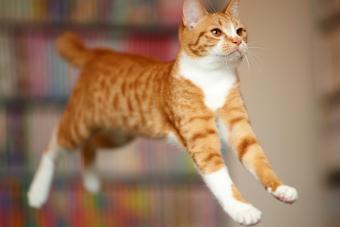
- Fur is marked with patches rather than swirls or bars
- Patches are a darker shade of orange than the rest of the body
- Traditional M marking is still present
- Cats can be bi-color with a spotted pattern and patches of white
Orange Cat Colors Come From Melanin
Orange tabbies can actually range from red to orange to yellow to buff. However, people generally refer to these cats as orange, no matter which shade they are. Melanin is responsible for producing color pigment, and it comes in two types:
- Eumelanin: This type of melanin produces a range of colors that include varying shades of black and brown, from dark to light.
- Pheomelanin: This type of melanin produces the color in a range from red (at its highest density) to cream (at its most dilute).
Orange fur in cats is created by the presence of pheomelanin, which produces shades of red.
Orange Tabby Is a Cat Fur Pattern, Not a Breed
Tabby is not a breed. It's simply a fur pattern that appears across a wide range of colors, including orange. Tabbies are found in many breeds, including Persian cats and British shorthairs, to name a few.
Most Orange Cats Are Male
There's an interesting link between the orange coloration and a cat's gender. The gene that produces the orange color is found on X chromosomes, so it's a sex-linked trait. Male cats (XY) inherit one X chromosome and one Y chromosome, so if the X they inherit contains the orange gene, they'll be an orange tabby.
It's a bit more complicated with female cats (XX), who inherit two X chromosomes. Both XX chromosomes must carry the orange gene in order for a female to be orange. That means if you have a female orange tabby, she's a very rare and special lady!
Approximately 80% of all orange tabbies are males.
More Orange Tabby Cat Facts
Want to know more? Orange tabbies are fascinating, so there are plenty of interesting facts about these pretty kitties.
- All orange cats are tabbies due to their genetic makeup.
- The orange gene dominates all other colors except for white, which is technically not a color but rather masks a cat's true color to some degree.
- Orange tabbies can have long or short fur.
- Many of these cats develop freckles on their noses and lips as they age. This is known as orange cat lentigo, and it's harmless.
- Tabbies generally have some degree of marking on their heads that resembles the letter M. This is more prominent in some cats than others.
- A buff tabby is still an orange tabby, just with dilute coloring.
Who Knew Color Could Be so Complicated?
Orange and white tabby cats may not seem quite as fancy or exciting as some other kinds of cats, but there's certainly a lot going on beneath the surface to produce one of these felines. Now that you have a better idea of what it takes for a cat to be an orange tabby, you'll probably never look at one the same way again.